*This post contains affiliate links.
I’ve been asked a few questions recently about what do when sight words just aren’t “sticking” for a child. My approach to literacy has and always will be a developmental approach. My developmental philosophy has been grounded by the authors of Words Their Way, and Linnea Ehri, a nationally known reading researcher.
Her article Phases of Word Learning, published in Reading & Writing Quarterly in 1995, was VERY helpful to me in understanding how kids learn words. She explains that there are phases of development in word learning with a typical learner. In her article, she lists 5 stages of word learning, but I’m only going to focus on the first three for the sake of time. She also explains in her article how each of these phases affects sight word knowledge. If your child is struggling in this area, maybe Ehri can offer you some help.
*Disclaimer: Learners with other reading differences, like dyslexia, may not fit into these categories so neatly
Phase 1: PRE-ALPHABETIC learners typically…
- have a very limited knowledge of letters (know very few letters or letter sounds)
- do not understand the connection between letters and sounds to help them read words
- can “read” environmental print (example: “Mommy, that says Chick-Fil-a!” when they see the sign for Chick-Fil-a)
- have trouble learning words apart from pictures or logos
- may remember a few sight words because of their shape or “picture”
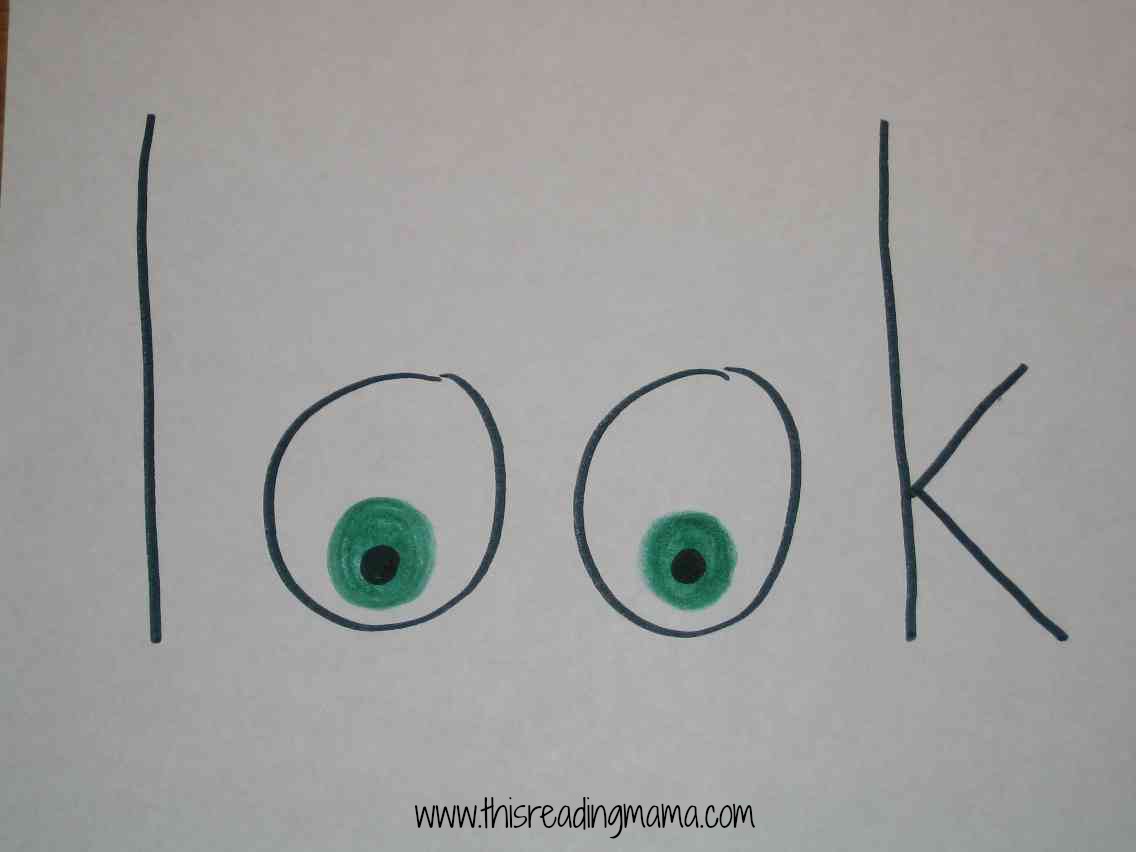 such as look (because it has two “eyes” in the middle)
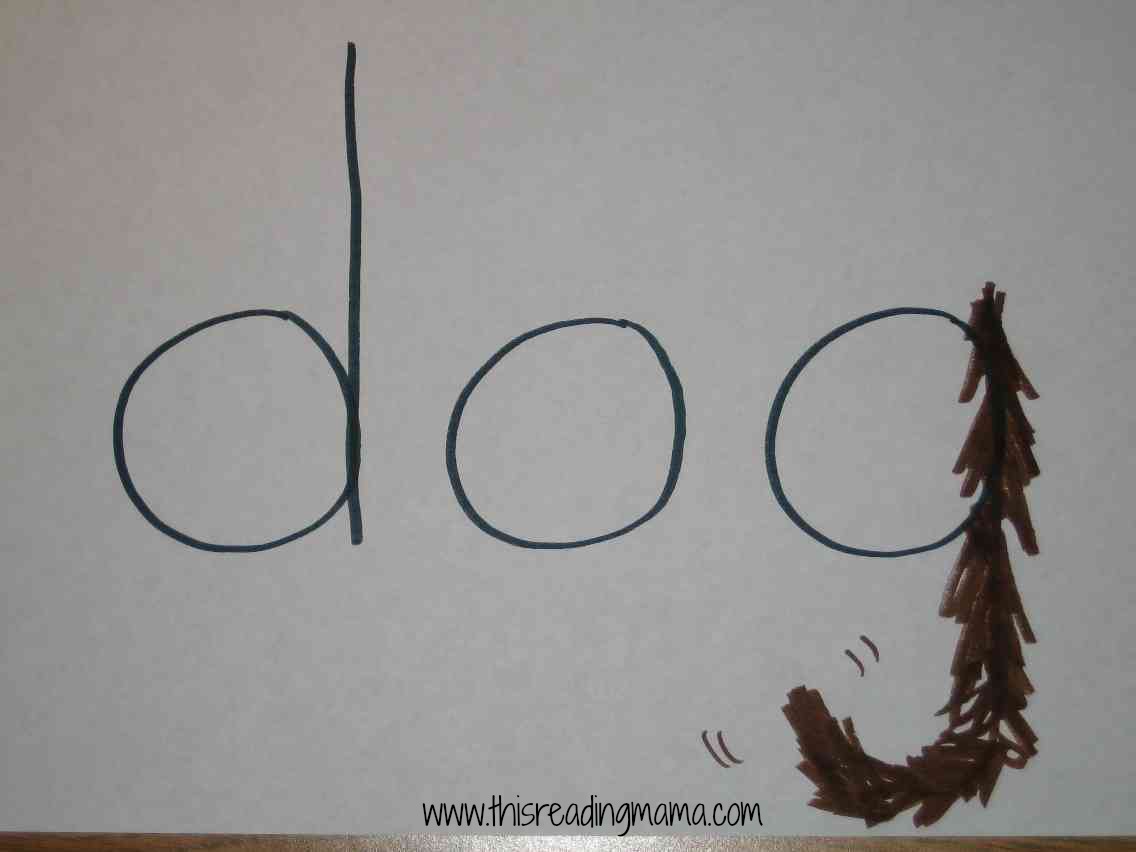 or dog (because it has a “tail”)
- can “pretend read” a book they’ve heard before and may even sound like they are reading the story word-for-word
In this phase, learning sight words will be extremely difficult because words are learned by their shape or “picture”, not by the individual letters or word patterns. I love how Dr. Francine Johnston calls this phase the “any clue will do” stage.
The problem with remembering words by their shape/picture is that there simply isn’t enough of a visual difference between words for the child to even have a chance! For example, when the child is faced with took, she will probably say it is look because took also has the two oo‘s in the middle that look like eyes. Big (because of its tail) may also be read dog. Ehri suggests that some readers may even say see for look because they can’t read the actual word, so their strategy is to remember the concept of the word. (142)
Some children move through this stage quickly, while others may move through it slowly. But no matter the age of your reader, if she is in this stage, sight words aren’t going to “stick” too well because there just isn’t much to “stick” them to!
Phase 2: PARTIAL-ALPHABETIC learners typically…
- can match some of the letters to their sounds (may know most of their letters, but not know more complex phonograms like sh, th, or ch)
- rely heavily on context clues to help them read (pictures or sentence structure)
- do not have strong decoding strategies to read unknown words
- use partial cues to read words- example: they may use only the first and last letter to help them read a word, so block may be read back.
In the partial-alphabetic phase, learning sight words is made a little easier, but “because their knowledge of the system is limited, and because they lack full phonemic segmentation ability, they process only partial-letter relations to form connections in learning sight words.” (145)
Sight words can be learned in this stage, but Ehri suggests teaching similarly spelled sight words separately. For example, teach words like no and on at separate times to limit confusion. I also suggest to take it VERY slowly.
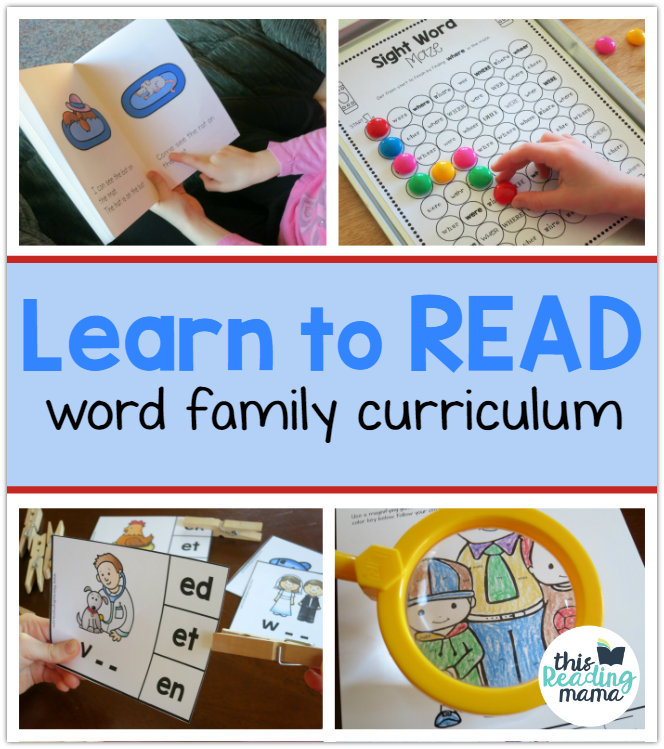
Even as kids progress closer to Full-Alphabetic Learners (see the next section), throwing lots of new sight words at them at one time is confusing. That’s why Learn to Read only introduces two new sight words a lesson. Each lesson builds on the last set of sight words, so review is factored in each lesson!
Phase 3: FULL-ALPHABETIC learners typically…
- understand and can process letter-sound correspondences, including vowels and other phonogram sets like ch or th
- can figure out unknown words by analogy (unknown word: blight, but can read it because she says, “Hmmm…this unknown word has the word light in it.”)
- text reading can still be slow and laborious at times
Children in this stage have a “sizable growth in their sight vocabularies as a result of reading practice” and new decoding strategies. (150) In this stage, sight words have a much better chance to “stick” because of the child’s understanding of how letters and words work.
Practical Ways to Help Words “Stick”
Because I’m a practical gal, here are a few suggestions for your child remember sight words when she shows signs that she is ready:
- When we first started, I created books for ALuv to read that focused on just a couple of sight words at a time, making the book very repetitive. For example: “I see a _____.” on each page. He’d fill in the blank and draw the pictures to go with it.
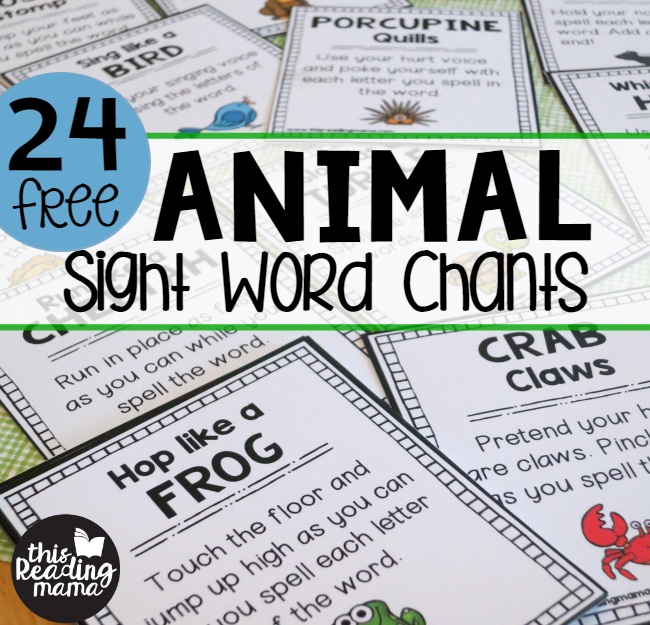
- Make it multi-sensory! Move and chant the words. I have two sets of FREE sight words chants you can download and use: 1- Animal Sight Word Chants and 2- People Sight Word Chants. My kiddos love these!
- When you’re working on a particular word, point it out every time you see it in text anywhere you see it. The great thing about sight words is that they are everywhere!
$20.00Add to cart
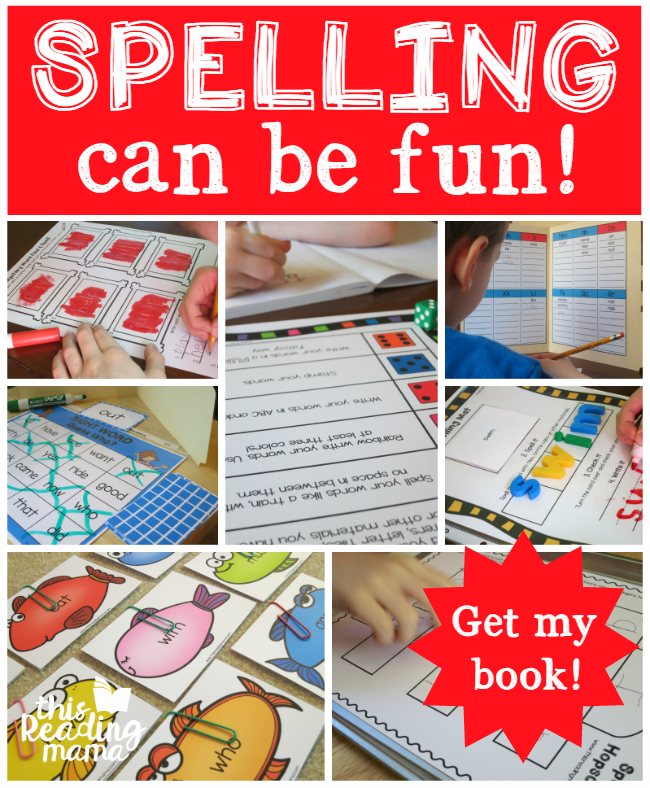
- Play games with sight words: Play simple games with dice, such as Sight Word Bump! or Roll and Write Sight Words. I have over 700 pages of printable spelling games and activities in my ebook, many of them for sight words! If you need even more ideas, our collection of 50 Hands-On Spelling Activities should help.
- Make a Word Wall where you can keep sight words you’ve worked on
- Review the Word Wall words frequently
- WRITE, WRITE, WRITE! When a child writes words, it builds that phonemic segmentation, the awareness of sounds in words, and gives them exposure to the sight words in a meaningful way.
- Be explicit in pointing out the tricky parts of some sight words. For example, show the word they and say, “Look at this word. The th makes the /th/ sound, like you know already, but the e & the y make the long a sound. That’s kind of tricky, isn’t it?”
- Sometimes I’ll simply ask the child, “What part of this word will be easy to remember?” or “What part of the word is tricky?” By taking the time to examine the word and the parts of it, you are helping them store it in memory better.
$9.99Add to cart
For more developmentally appropriate tips for spelling, check out my ebook, Teaching Kids to Spell: A Developmental Approach to Spelling.
Follow This Reading Mama’s board Sight Words on Pinterest.
Follow This Reading Mama’s board Hands-On Spelling Ideas on Pinterest.
Follow This Reading Mama’s board Word Study/Phonics on Pinterest.
~Becky
Comments
Trackbacks
-
[…] of my favorite posts has got to be my Sight Word post. It’s all about why sight words don’t stick and keeping with developmentally appropriate practices when we teach […]
-
[…] Introduction of sight words depends mainly on the developmental stage of your child. Age can also play a factor, but don’t let that be your deciding factor. The developmental stage of your child should be your main indicator. For example, NJoy started showing me he was ready for sight words at the age of three. He was highly interested and knew all of his letters and sounds. Your child may be in the 1st grade, but in the same developmental stage as my son was at three. Pay attention to this. For more information about teaching sight words in a developmental way, please visit my post: When Sight Words Just Don’t ”Stick”. […]
-
[…] based on the words your child already knows or needs to know. Start simple. Sight words need to be introduced slowly with children just learning to […]
-
[…] them! Here is another great blog post with more ideas for teaching these types of words, and a different one for those who struggle with learning […]
You do an amazing job of helping parents teach their kids. This post gives a lot of helpful ideas!
Thanks, Michelle! And thanks for linking to me on your post!!
This is really helpful! Thanks! I have a 6 year old and she has the hardest time remembering… thanks!
I know you know the bed and pig trick.
Hold your thumbs up, make a fist.
Put your fist together, this makes a bed. (It helps with that pesky ‘b’ and ‘d.’)
Now put your thumbs towards the floor and curl up your right hand thumb, slightly, this makes a little pig. (It helps with ‘p’ and ‘g.’)
My favorite trick for the b and d reversal is asking the child to draw a capital B; then draw the lower case b inside. It fits nicely. 🙂
Love your ideas with sight words, will try some. I have an 11 yr old that is still not reading. I think he is dyslexic, but am having a really hard time of getting him tested. We have used like 3 different phonics programs and none work. I have used Teach Your Child to Read in 100 Easy Lessons, that didn’t work either. At this point, I am ready to try anything.
Wow. Have you read Marianne Sunderland’s Dyslexia 101 {affiliate link on my sidebar}? She has 8 kids, several with dyslexia, and has great tips and helps there including curriculum ideas for teaching children with dyslexia. Even if you find out he’s not dyslexic, Marianne’s tips are dead-on for teaching struggling readers. Praying for you right now that you will find what works for your son.
As a teacher, I needed this encouragement this morning. Yes, I know they aren’t there yet, but remembering that there are stages of development and this is the way God made us helps a bit. My kiddos will get there, just not today!
Amen!
When I began to understand the developmental stages of reading, writing and spelling, those students that were struggling weren’t such a puzzle to me any more. 🙂
Thank you for all the helpful comments. It’s fustrateing at times but we need to remember we also were there once too. Someone helped us through. ☺
Robin Rose Howell, Has your child made reading progress? When you were trying programs, did you try “Barton” or “All About Reading”?
Yes, those are both great programs for teaching reading. The more explicit, systematic, and “multi-sensoried” you can get, the better.
@Robin Rose- My son is also dyslexic. As an educational specialist, I’ve found that you need to address the underlying deficits that are preventing kids from learning how to read. For kids with dyslexia that generally means strengthening their auditory memory (most important) and visual memory (also important, but less so).
A good analogy is to imagine someone who has a broken leg being given endless suggestions for walking better: using a cane, rehab, positive self-talk, etc. None of these will work unless the broken leg is fixed.
I know that with my son I tried all kinds of interventions – and I know a lot- and none of them worked until I dealt with his underlying issues.
Hi there I just wanna say the for the great tips and ideas.I have tried numerous diff things with my 6 yr old it is just not sticking his teacher told me that if he can’t get the sight words to stick she wants to hold him back in kindergarten another year Cuz he’s just not ready he can write he does very well with math he excels with everything she throws at him except for the words.I have spent a ton of money on my baby can read flash cards numerous games.its like the first 5min I have his attention after that I loose him he completely give up.I’ve tried to talk to his Dr about this but they say it’s normal.idk what to do anymore it’s so frustrating because he is so smart and I don’t want him to get depressed and upset when he sees all his friends moved on except for him.idk what to do anymore.
Hi, Becky,
I am also a reading specialist, and Linnea Ehri’s research has probably been the biggest influence on my teaching than any other researcher. I’m so glad you follow her work, too. While teaching first graders one-on-one, I’ve noticed them progress through Ehri’s stages, as you have witnessed with your children.
Thanks for sharing what you have. I love your website.
Best,
Ann Staman Hollingworth
ManyRoadstoReading.com
So glad to have you here. 🙂
I have been subscribed to your site for about ten days but I have not received any info from you. I was hoping to get some of your awesome freebies. I have purchased some of your products on TPT. Love them!
What should I do?
Are you getting my newsletters?
Hi Becky, I just love your resources and posts. I’m a dyslexia specialist and use them often. I’m looking to make some of my own and I’m wondering which program you use to create your worksheets?
I use PowerPoint and then save my resources as a PDF. 🙂 Hope that helps.
Really nice post! Thanks for sharing useful & great ideas.