What’s the Difference between balanced literacy and structured literacy?
The main purpose of this video series has been to explore and explain the differences between some of the terms and concepts used in the field of literacy. Today, I’m covering the last comparison in this series: balanced literacy and structured literacy.
*I am a participant in the Amazon Services LLC Associates Program, an affiliate advertising program designed to provide a means for me to earn fees by linking to Amazon.com and affiliated sites.
Disclaimer: I want to be upfront and say that was a balanced literacy teacher and advocate for many years. I can only speak to my experience. Other professionals may have a different take on what balanced literacy is and how it compares with structured literacy.
What is Balanced Literacy?
Balanced literacy seeks to balance the teaching of literacy skills through direct instruction done by the teacher all the way to independent activities done by learners. Balanced literacy focuses on both reading and writing, but today, we’re just going to tackle the reading aspect of it.
The four main activities for reading are:
- Teacher Read Alouds – where the teacher models and students are actively watching and listening
- Shared Reading – In this activity, learners have access to the text while the teacher does most of the reading
- Guided Reading – small group instruction in which learners all have access to the text and are expected to read it with support from the teacher
- Independent Reading – learners are expected to read text on their own at their independent level
So, as you can see, going from activities one to four, you are gradually moving the responsibility away from the teacher and onto the student.
Another feature I see with balanced literacy is that it attempted to strike a balance with the “reading wars” between whole language (which essentially was full immersion of language without needing to teach the nitty-gritty things like letter and sounds) and then heavy phonics instruction (with very little use of quality texts)
Lastly, balanced literacy desires that kids ENJOY reading. It’s not as focused on helping kids “crack the code” of reading.
The text in this blog post is from my video.
Watch the full video on my YouTube channel.
Concepts within the Balanced Literacy Framework
- Memorization of difficult sight words
- Teaching reading skills if and when they are needed instead of a systematic or intentional way of teaching them
- The focus is on the activities themselves – read alouds, shared reading, guided reading, independent reading
- Using context to guess at words; this is also known as MSV or 3-cueing and it’s is heavily used for keeping Running Records; the focus being the MEANING of the text; not what each word actually reads
- Reading Workshop – developed by Lucy Calkins {I read almost all her books}
I want to reiterate that every school and every teacher is different. I’m painting the balanced literacy picture with a broad stroke brush here. It will most certainly vary from school-to-school and teacher-to-teacher.
For example, I taught using the balanced literacy framework, but because I taught at a school with many English Language Learners and children who were considered “at risk,” we integrated loads of phonemic awareness and phonics instruction that I would say was more on the intentional side. We still embraced guided reading and using 3-cueing to guess unknown words, but helping kids “crack the code” was a big part of our two-hour reading block every day.
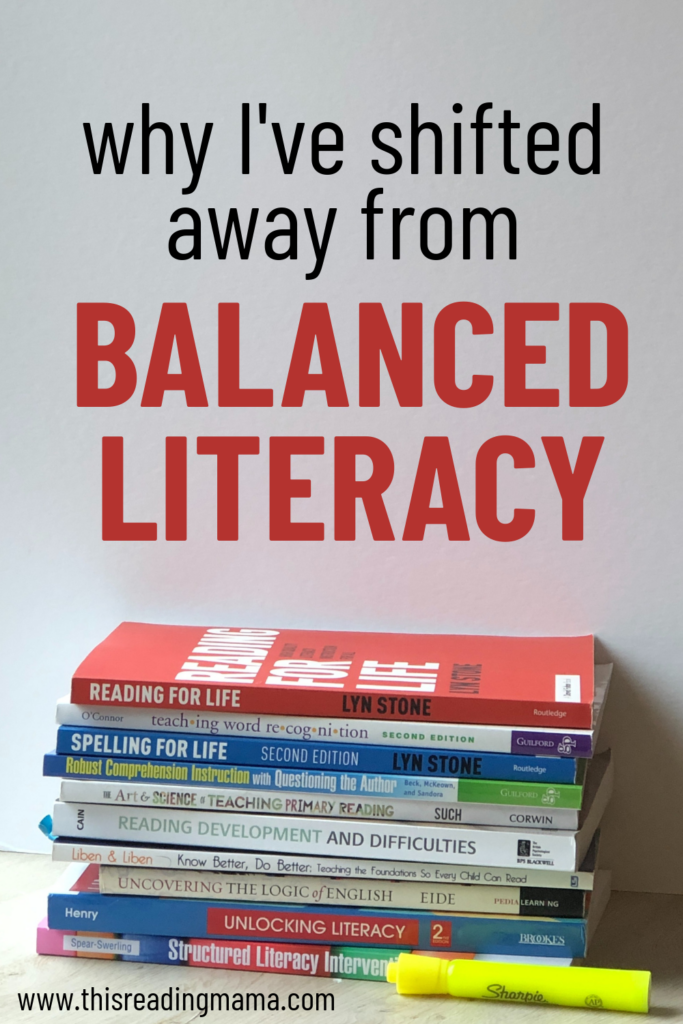
Read more about why I’ve shifted away from balanced literacy.
What is Structured Literacy?
The structured literacy framework teaches the structures of literacy. {Follow the links to learn more about each.}
They would include:
- Phonology
- Sound-Symbol Associations
- Syllables
- Morphology
- Syntax or Semantics
If those words sound a little too “text-booky,” it may help to think of them in these terms:
- Phonological awareness – with a heavy focus on phonemes, which are the individual sounds in words
- Phonics – connecting the letters to their sounds
- Multisyllable words – reading words longer than 1 syllable
- Teaching word parts and word meanings – for example the prefix un- means “not” (un would be a morpheme)
- Grammar/Vocabulary
All of these structures feed into comprehension when reading.
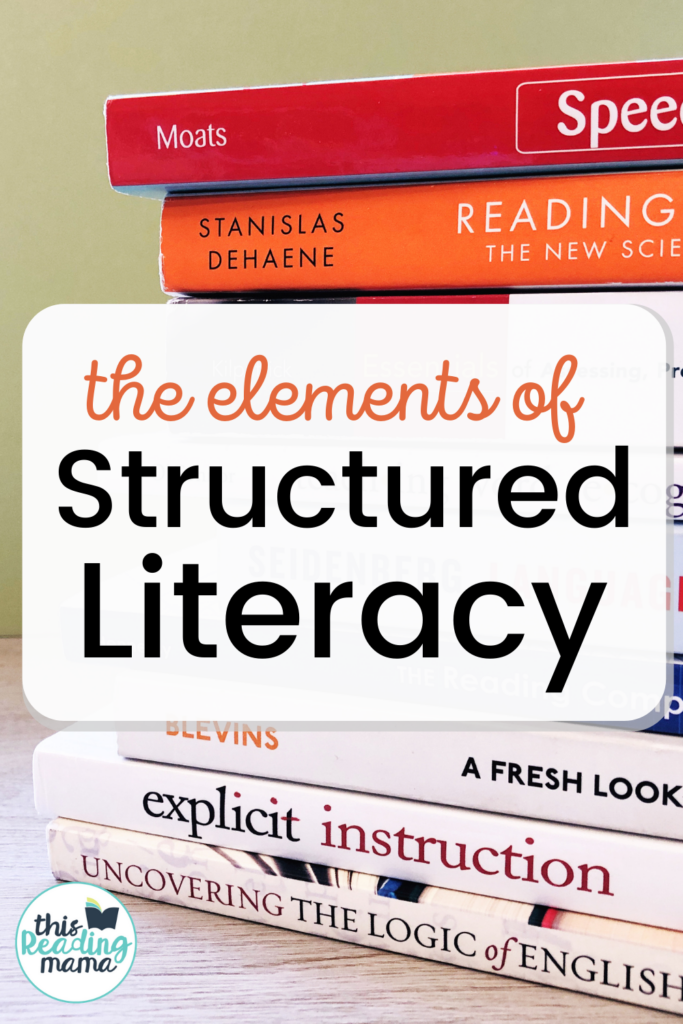
Structured literacy also focuses on the KIND of teaching we’re doing.
- Explicit – spell it all out, there’s nothing left to chance
- Systematic – with the new skill building off the last one
- Cumulative – review is built it so you’re keeping everything you’ve taught up until this point fresh
- Diagnostic – relying on the observations you make, the data you collect, to drive your instruction
This kind of teaching is what Burkins and Yates of Shifting the Balance call “intentional teaching.”
The desire of structured literacy is to be a benefit ALL our learners.
While a percentage of readers may take off under the balanced literacy framework (say 30-40%), ALL learners can benefit from the intentionality of the structured literacy framework. The goal of structured literacy is to make reading easier, not harder for all learners.
Some of the “buzz words” you may hear within the structured literacy framework are:
- mapping phonics and sight words – the idea of orthographic mapping is huge, as we help learners connect the letter to their sounds in how words are spelled, even with sight words
- intentional teaching, which follows a scope and sequence; we have explicit, systematic, and cumulative teaching
- decodable readers – instead of using leveled books
- “The Science of Reading” – this entire movement came on the heals of getting a deeper understanding of the science behind how the brain learners to read
Enjoy teaching!
~Becky
“While a percentage of readers may take off under the balanced literacy framework (say 30-40%), ALL learners can benefit from the intentionality of the structured literacy framework.”
Hi Becky, do you have a reference for that figure? I don’t have one, but I’d put it closer to double that. Which is where my problem with structured literacy comes in: it’s great, it works, but it can be boring for a lot of kids who learn faster without it.
I have been advocating for structured literacy for struggling readers, and I’m glad to see my board demand that it be integrated into primary literacy blocks, but I’m seeing a lot more ‘sit still and listen’ with grade ones being kept on the carpet for longer and longer. Or maybe it’s my imagination.
Again, thank you for your work. I love the blog and I find it really useful.
I hear you! I think it’s definitely a challenge to make structured literacy engaging. That’s what I’ve noticed. I also don’t buy into asking kids to sit longer, as that is not developmentally appropriate. The chart with the percentages that I was referencing came from this website -> https://www.nancyyoung.ca/ladder-of-reading-and-writing