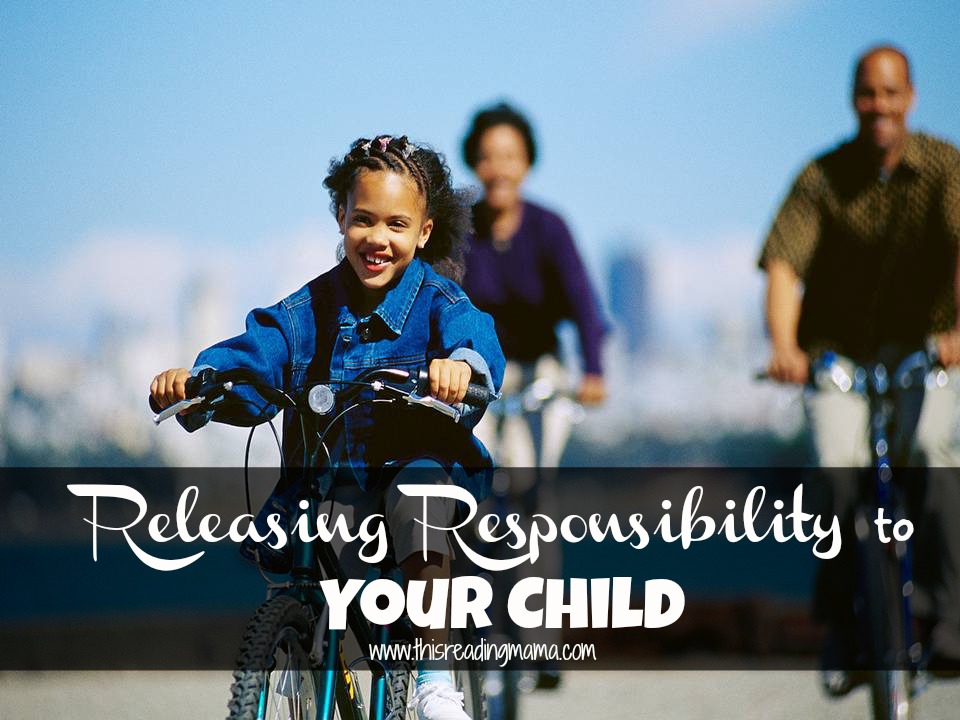
Have you ever been frustrated trying to teach a child how to do something? I know I have!
But there are some simple steps you can follow to minimize the frustration for you and your child. The official name of the steps I will list below is The Gradual Release of Responsibility or scaffolding. It works beautifully when teaching learners pretty much anything, from rhyming to riding a bike!
In the following steps, you only ask the child to work independently after she has been given the strategies for which to do so.
Let’s taking rhyming words, just as an example:
1. Model explicitly what you want the child to do over and over.
You: “I know some words that rhyme with cat. Listen to this: sat, bat, fat, mat, pat, etc. Can you hear how they sound alike?” or “Wow, did you hear those two words in that book? They rhyme!”
This is not just a one-time shot. It may take days or weeks of modeling before you try the next step. Explicit modeling means you explain your thinking and your strategy as you model it. This builds up her strategies for tackling the task herself.
2. You model again asking your child to take a more active roll.
You: “Cat and bat rhyme. Does elephant rhyme with cat?”
If the child answers incorrectly, be ready to model for her again. You might say, “A cat and an elephant are both animals, but they don’t rhyme. Cat and sat rhyme.”
3. Let her try it independently. Be ready to provide support, if needed at times.
You: “Let’s play a rhyming game. Let’s see how many words we can think of that rhyme with cat. Can you tell me a word that rhymes with cat?”
Child: “Rat.”
In step #3, the child takes an even more active role, but you are still there to provide the support that may be needed.
4. Independent Practice.
Child: “I just heard two rhyming words in that poem: star and car! And I know another one…jar!”
In this step, the child is able to think about the strategy or skill in a more flexible way, even applying it in different situations independently at times.
As you’re busy teaching, always remember these four steps in releasing responsibility. It will help to reduce frustration for both of you!
Enjoy teaching!
~Becky
Comments
Trackbacks
-
[…] frustration for you and your child. One of the practices I learned from developmental teaching is gradually releasing responsibility to the child. This means modeling and teaching in the zone {see #4} with lots of support; then […]
Most parents don’t realize that in releasing responsibility to the child, they are building their child’s confidence in his/her self. It is one of the best things we can do.
Congrats on your work anniversary! Thirteen years is a great milestone on your blog post! Thank you for all you do for us!
Thank you for clearly laying out the process of releasing responsibility to a child! I have been an educator for 34 years and one of the most frustrating thing I hear teachers say is, “You are in (xyz) grade now. You should know how to do that.” We have to train children and prepare them before we can release them.
I want to thank you so much for all your time and effort in providing resources for us all. When I began my adventure to home-educate my daughter, I had no clue where to begin… then I found you! You are my North Star ⭐️, thank you for being my compass, navigating my daughter and I to the ultimate treasure! #Inspiring,andThriving!